
The Hill-Burton Plot Twist
In the 1940s, the U.S. had a very specific problem: lots of humans, not a lot of hospital beds.
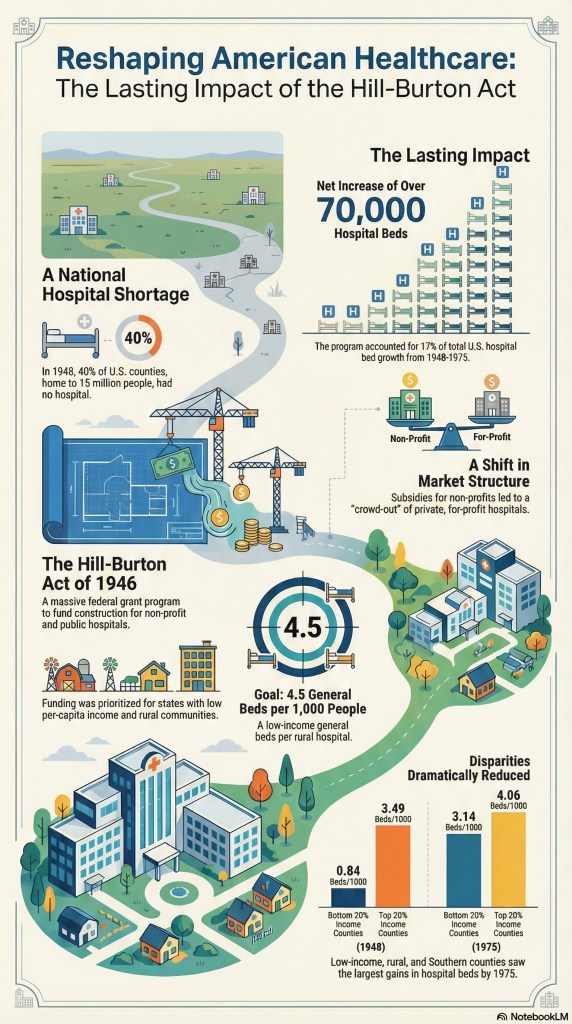
By 1948, about 40% of counties—15 million people—had no hospital at all. If you crashed your tractor in rural America, your trauma protocol was basically: “Step 1: don’t crash your tractor.”
Enter the Hill-Burton Act of 1946: Washington’s decision to start air-dropping hospital blueprints and grant money. Lawmakers even picked a magic number: 4.5 general beds per 1,000 people, with extra love for poor and rural areas. Somewhere, a policy nerd with a slide rule was very proud.
The result was a full-on construction binge. Hill-Burton helped add over 70,000 beds, and by the mid-1970s low-income counties had nearly caught up with wealthy ones. Medical deserts upgraded to, “We actually have an ER now, please don’t bleed on the registration desk.”
The fine print, of course, was less inspirational. Hospitals were supposed to provide some free care and not discriminate—while still being allowed “separate but equal” (white & colored people) setups for a while. Charity care was fuzzy, loosely enforced, and often temporary. The bricks arrived faster than the ethics.
Economically, it’s a neat trick: we socialized the infrastructure (tax dollars for buildings) while privatizing the revenue (insurance, billing, and everything that makes your EOB look like abstract art). Non-profit hospitals, freshly subsidized, often pushed out for-profits—then learned to play the capitalist high-score game better than anyone.
So the infographic you’re looking at isn’t just about beds. It’s a snapshot of the moment the U.S. quietly decided that the front door of healthcare would be a hospital. The question Hill-Burton leaves us with is simple and uncomfortable:
If you build the system around beds, do you inevitably get a healthcare economy where everyone’s job is to keep those beds full?

Leave a comment