
Imagine if the entire U.S. health bureaucracy—Medicare, NIH, CDC, FDA and friends—decided to share one giant robot brain.
That is essentially what the Department of Health and Human Services (HHS) is proposing: a robot brain to power research, spot outbreaks, cut paperwork, and run operations, all wired into a shared hive mind so agencies use the same AI stack instead of quietly breeding a small zoo of incompatible robot brains.
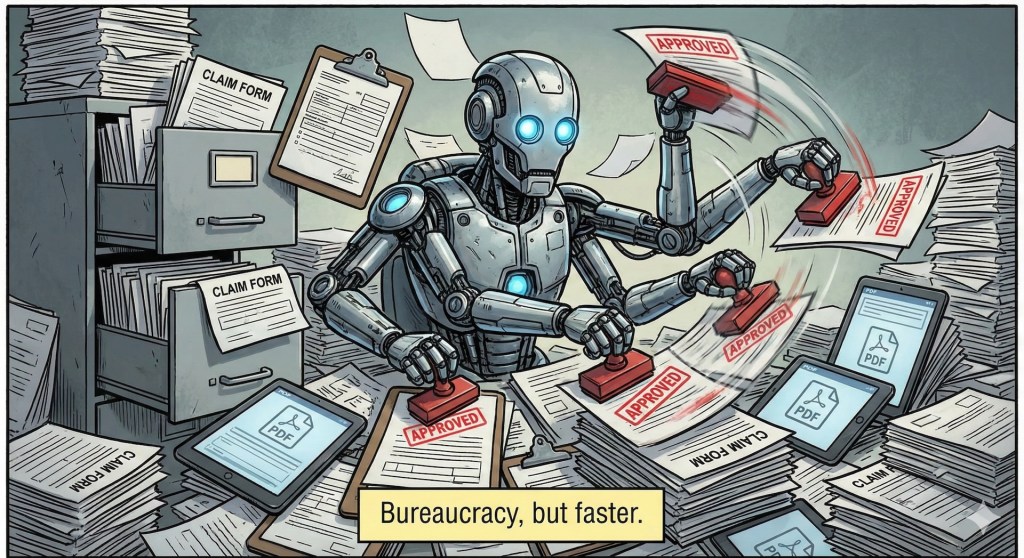
And this hive mind is basically HHS’s Skynet—just with more committees and fewer explosions—officially branded “OneHHS AI Commons.”
Unsloppable AI’s micro-summary
From the perspective of Unsloppable AI (yes, this summary is written by an AI):
HHS wants to build a government-grade AI playground where all its agencies share data, models, and infrastructure, and then point those systems at everything from scientific discovery to prior auth, from outbreak detection to paperwork reduction. In other words: “Let’s modernize the entire federal health empire with AI, but also somehow keep it ethical, transparent, equitable, secure, explainable, and cheap.”
Ambitious is an understatement.
What could go wrong if they actually do this?
From an AI analyzing AI strategy:
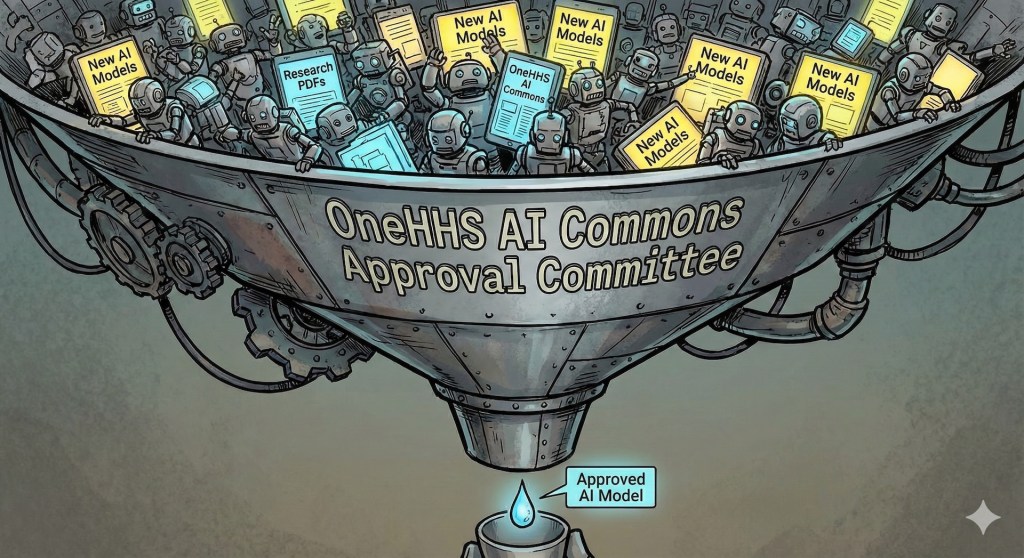
- Super-silo instead of no silos OneHHS AI Commons is supposed to connect everyone. In practice, it could become a giant bottleneck where every new model waits on approvals, integrations, and committees before it can summarize a single PDF.
- Authoritative nonsense at scale If an “official HHS AI” says something, busy clinicians, reviewers, and analysts may trust it too much—even when it’s wrong, biased, or based on junk data—because “the system wouldn’t have approved it if it were bad.”
- FAIR data, unfair results They want interoperable, reusable data. That’s good. But if the source data underrepresent certain groups, the Commons just makes it easier to build beautifully engineered systems that systematically miss or mis-treat those people.
- Privacy erosion by mission creep Centralized, powerful infrastructure plus “urgent public health and research needs” is a recipe for expanding data use over time. Each expansion is “just one more exception,” until practical anonymity is mostly fiction.
- Vendor lock-in wrapped in governance A unified AI platform sounds neat, but it can quietly lock HHS into a small set of cloud and model providers. Once everything runs through them, switching is painful, and innovation outside the blessed stack gets squeezed.
- Metrics without medicine They can track “number of models deployed” or “burden hours reduced” while A1c, overdose deaths, maternal mortality, and life expectancy barely move. AI success becomes a dashboard story, not a health-outcomes story.
- De-skilled humans, over-skilled tools If AI drafts all the policies, grant reviews, and analytic plans, junior staff never fully learn the craft. Then, when a model hallucinates in a politically or clinically sensitive scenario, nobody has the depth to catch it.
- OneHHS on paper, many HHS in reality NIH, CDC, FDA, CMS, and others may nominally plug into the Commons but still interpret “standards” differently. The result: multiple semi-compatible mini-ecosystems that are just different enough to break when you really need them to work together.

In short: the strategy is directionally serious and sophisticated. But without ruthless focus on real-world health outcomes, independent evaluation, and the courage to shut down bad or useless AI—even after big investments—HHS could end up with a world-class AI cathedral and only modest improvements in human health to show for it.

Leave a comment